Cart
0
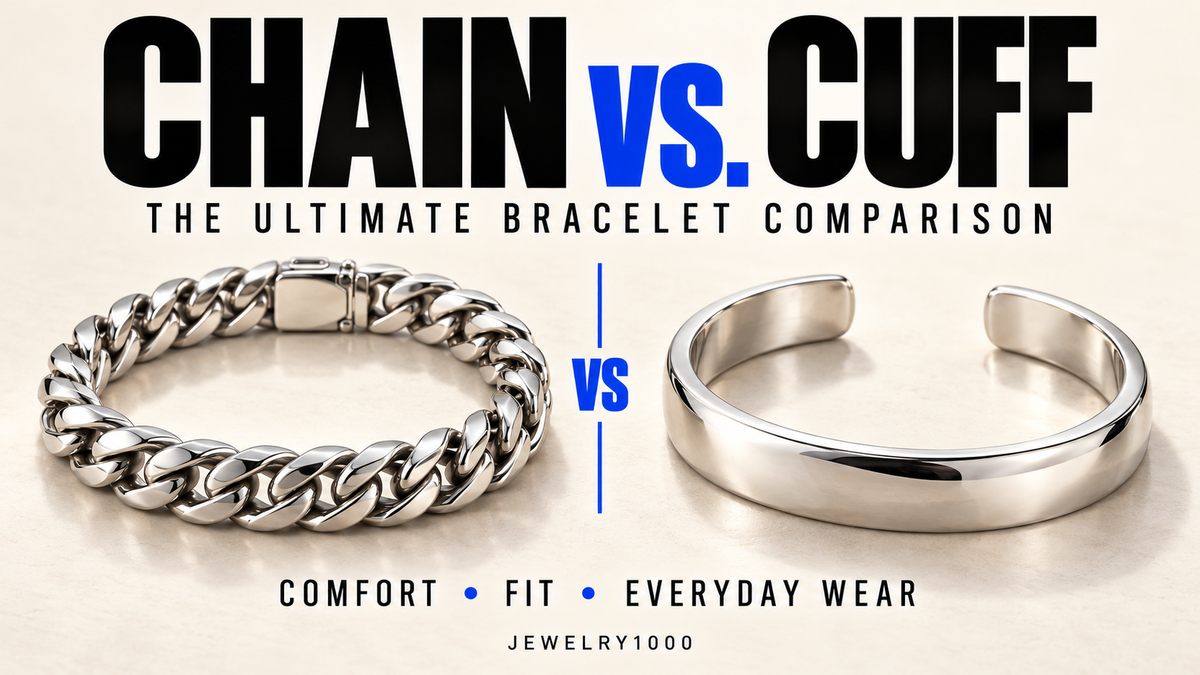
You might like the look of a bracelet, but would you enjoy wearing it all day? A clasp that’s awkward to fasten, a bracelet that crowds your watch, or an edge that presses against your wrist while typing can make you reach for something else.
Choosing between a chain bracelet and a cuff comes down to these small, practical details as much as appearance. Think about how you usually dress, whether you wear other accessories, and how you like a bracelet to sit on your wrist.
Below, we compare the two types using a five-star scoreboard. More stars mean a better fit for that particular habit or situation—not a better bracelet overall. We’re focusing on everyday, medium-width silver designs, with notes where size, shape, or construction changes the comparison. Start with the aspects that matter most to you; there’s no need to add up the scores.
Chain vs. Cuff: The Scoreboard
A chain bracelet moves with your wrist, while a well-fitted cuff tends to hold its position. Each has advantages, depending on what you do during the day and whether you wear other jewelry.
The ratings below are practical buying judgments, not test results. We’re comparing a medium-width chain bracelet with a little room to move against a smooth, oval cuff fitted close to the wrist.
|
Aspect |
Chain bracelet |
Cuff bracelet |
|
Putting on and taking off |
★★★☆☆ — Fastening a clasp with one hand can take practice. |
★★★★★ — An open cuff has no clasp to fasten. |
|
Flexibility around the wrist |
★★★★★ — Links move freely and follow the wrist’s shape. |
★★★☆☆ — Holds its shape, so the dimensions need to suit your wrist. |
|
Staying in position |
★★★☆☆ — Can slide and rotate during wear. |
★★★★☆ — A well-fitted oval cuff tends to stay in place. |
|
Comfort at a desk |
★★★★☆ — Easier to shift up your arm, away from the desk or keyboard. |
★★★☆☆ — A close fit makes it harder to reposition if an edge presses against the desk. |
|
Fitting beneath close sleeves |
★★★★☆ — A low-profile chain follows the wrist beneath a sleeve. |
★★★☆☆ — A rigid profile may catch at a fitted shirt cuff. |
|
Sharing a wrist with a watch |
★★★☆☆ — A loose chain can slide against the watch as you move. |
★★★★☆ — A fitted cuff tends to stay beside the watch, provided there is enough space. |
Fit can change these advantages. A chain pushed up your arm may slide back down, and an oversized cuff won’t stay neatly beside a watch. Thickness matters too: a chunky chain may be harder to fit beneath a sleeve than a slim cuff.
There’s no total score because the priorities are yours. If you dislike fastening small clasps or want a bracelet that stays in position, a cuff has the edge. If you prefer flexibility and the freedom to shift your bracelet around, a chain is worth a closer look.
What the Scores Mean in Everyday Wear
Comfort, movement, and sleeves
A chain bracelet gives you room to move it around. If it rests against the desk while you type, you can shift it farther up your arm, though it may slide back down. Pay attention to the clasp as well as the links: a large clasp beneath your wrist can be more noticeable than the chain itself.
A cuff’s comfort depends more on how closely its shape matches your wrist. Too tight, and the edges or ends may press into your skin; too loose, and it can turn sideways. A good fit lets it sit comfortably without needing frequent adjustment. An open cuff is also quicker to put on, but it shouldn’t need to be bent open and squeezed shut every time.
With fitted shirt cuffs, look at the bracelet’s thickness. A flat Cuban chain may tuck beneath a sleeve more easily than a raised, sculpted cuff. A slim cuff, however, can take up less space than a chunky Byzantine bracelet.
Wearing a watch or stacking bracelets
If you want a bracelet beside your watch, a close-fitting oval cuff is worth considering. Its more stable position can help keep the two pieces apart, provided there’s enough room. A loose chain has more freedom to slide toward the watch. If they repeatedly knock or rub together, wearing the bracelet on your opposite wrist is a simple solution.
For stacking, think about how you want the pieces to sit. A chain mixes naturally with leather or beads when you like a relaxed arrangement that moves with you. A fitted cuff can give the stack a more defined position. Start with two bracelets, and check how they feel when your wrist bends—you may find that’s all you want.
Matching your clothes
With a plain T-shirt and jeans, either type works. A polished chain adds a linked texture and some movement; a smooth cuff creates a more continuous band of silver. Choose the effect you prefer rather than assuming one is automatically more casual or dressy.
For a button-down shirt or a smarter outfit, a moderate width and restrained detail are easy starting points. With heavier clothing, such as denim or leather jackets, a substantial chain or engraved cuff can hold its own visually. The finish and design matter more than the category: a plain cuff and an ornate cuff can look further apart in style than a plain cuff and a simple chain.
Which Fits Your Habits?
Start with the situation you encounter most often. A bracelet that suits your usual routine is more likely to get worn than one chosen for an occasional outfit.
|
Your wearing habit |
A good starting point |
What to look for |
|
You wear a watch every day |
A slim oval cuff for the same wrist |
A close, comfortable fit and enough space to avoid rubbing against the watch. If you wear the bracelet on your other wrist, either type works. |
|
You spend hours typing |
A flat chain bracelet with a small clasp |
Enough room to shift it away from the desk, without so much slack that it constantly slides back toward your hand. |
|
You want one simple accessory |
A plain cuff or a medium-width Cuban chain |
Choose the cuff for a continuous band of silver, or the Cuban for visible links and movement. |
|
You already wear leather or beads |
A slim chain for a loose stack, or a fitted cuff for more separation |
A width that leaves the other bracelet visible and enough room to bend your wrist comfortably. |
|
You struggle with small clasps |
An open cuff |
An opening that lets you put it on without repeatedly bending the silver. |
|
You often wear fitted sleeves |
A low-profile chain or slim cuff |
Modest thickness, smooth edges, and a clasp or decorative detail that won’t catch at the sleeve opening. |
If you’re buying your first silver bracelet and still feel undecided, ask yourself whether you enjoy some movement around your wrist or prefer jewelry to stay put. That preference is a useful starting point: a chain generally offers more movement, while a properly fitted cuff offers a more stable feel.
Before You Buy
Once you’ve chosen a type, check the details of the actual bracelet. Width, weight, fit, and fastening can make two similar-looking designs feel quite different on your wrist.
For a chain bracelet, start with your wrist measurement and the product’s sizing guidance. The listed length needs to leave room for a comfortable fit, but the amount depends partly on the thickness of the links. A chunky chain takes up more space around the wrist than a fine one, so don’t assume the same length will fit both equally well.
Look closely at the clasp, too. Consider whether you can operate it with one hand and whether its size might bother you beside a watch or beneath your wrist. Check the gram weight if you prefer a lighter bracelet or enjoy something more substantial.
For a cuff bracelet, check the internal dimensions and the opening. An oval cuff’s width and depth help you judge how its shape will sit around your wrist; the opening matters when putting it on and removing it. Wrist circumference alone doesn’t tell you everything about the fit.
Follow the adjustment guidance for that particular cuff. Don’t assume every silver cuff can be resized, and avoid repeatedly bending it open and squeezing it closed as part of your daily routine.
When browsing our silver chain bracelets and cuffs, use the comparison above to narrow your choices, then check each product’s measurements. If you’re unsure, send us your wrist size and the design you’re considering. Let us know whether you plan to wear it beside a watch or with other bracelets, so we can help you choose a suitable fit.